

How Long Is 10,000 Steps on a Treadmill?
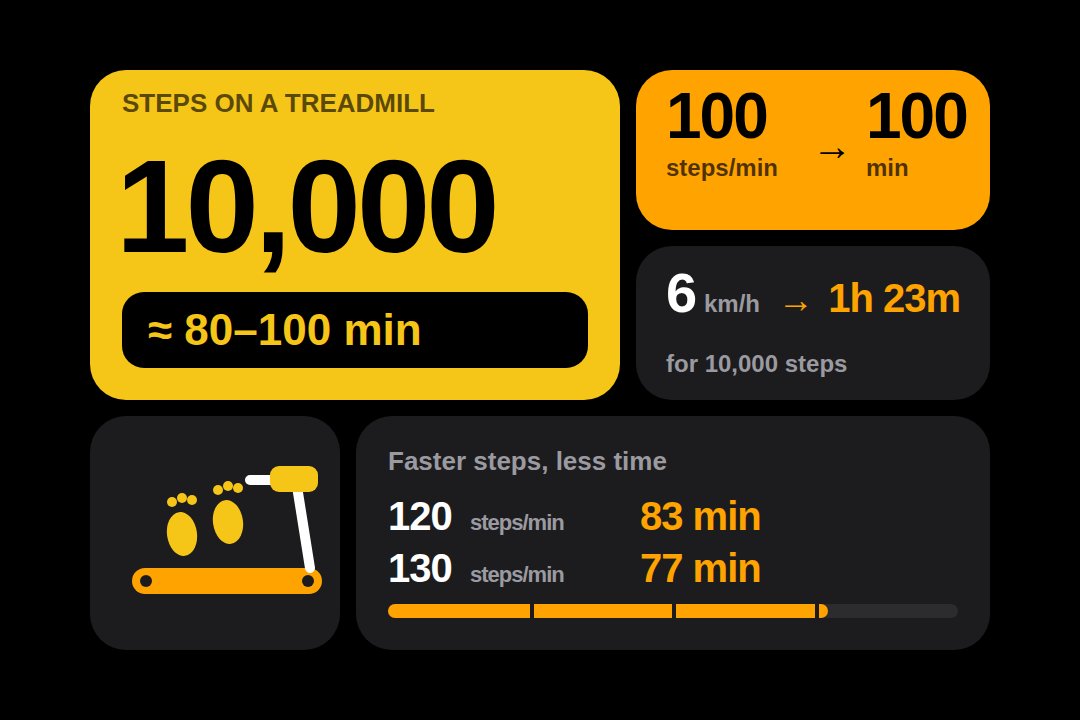
How long is 10k steps on a treadmill? Most walkers need 80 to 100 minutes. See times by speed and cadence, and how to split the total into a busy day.
On this page
How long is 10k steps on a treadmill? For most adults walking at 5 to 6 km/h, the answer is somewhere between 80 and 95 minutes of belt time, and closer to 60 minutes if you jog. The exact figure depends on one number more than any other: your cadence, or steps per minute. This guide shows how to work out your own time, what changes it on a treadmill compared with walking outside, and how to fit the total into a normal day. Once you know your time commitment, walking on a treadmill and weight loss covers what to expect from that daily routine.
The Simple Math: Steps Divided by Cadence
Time for 10,000 steps is just 10,000 divided by how many steps you take each minute. Speed, height and incline only matter because they change that cadence.
- 90 steps per minute: about 111 minutes
- 100 steps per minute: 100 minutes
- 110 steps per minute: about 91 minutes
- 120 steps per minute: about 83 minutes
- 130 steps per minute: about 77 minutes
- 160 steps per minute (easy jog): about 63 minutes
Those cadence numbers are not arbitrary. A 2019 study in the International Journal of Behavioral Nutrition and Physical Activity proposed 100 steps per minute and 130 steps per minute as reasonable heuristic thresholds for moderate and vigorous walking intensity in adults aged 21 to 40. A 2023 paper in the same journal notes that 100 steps per minute is widely used to define moderate-intensity walking.
So if you want your 10,000 steps to count as moderate exercise rather than pottering, plan on 100 minutes or less of walking time. That is the ceiling, not the target.
Estimated Time by Treadmill Speed
Most people set the belt by speed, not cadence, so here is a rough conversion for an average adult of about 165 to 180 cm walking on a flat belt. Cadence and step length vary from person to person, so treat this table as a starting point and check your own numbers with the method in the next section.
| Speed (km/h) | Approx. cadence (steps/min) | Approx. step length | Time for 10,000 steps | Distance covered |
|---|---|---|---|---|
| 3.0 | 90 | 0.56 m | 1 h 51 min | about 5.6 km |
| 4.0 | 100 | 0.67 m | 1 h 40 min | about 6.7 km |
| 5.0 | 110 | 0.76 m | 1 h 31 min | about 7.6 km |
| 5.5 | 115 | 0.80 m | 1 h 27 min | about 8.0 km |
| 6.0 | 120 | 0.83 m | 1 h 23 min | about 8.3 km |
| 6.5 | 125 | 0.87 m | 1 h 20 min | about 8.7 km |
| 8.0 (jog) | 150 | 0.89 m | 1 h 07 min | about 8.9 km |
| 10.0 (run) | 160 | 1.04 m | 1 h 03 min | about 10.4 km |
Two patterns stand out. First, going from 4 to 6 km/h saves you about 17 minutes, which is a big return for a speed most people can hold comfortably. Second, once you start running, the time barely drops, because running adds mostly step length rather than steps. If you want the pace equivalents for these speeds, the treadmill speed chart converts every setting to minutes per kilometre and per mile.
Why Treadmill Steps Are Not the Same as Outdoor Steps
People who walk both indoors and outside sometimes notice their step count climbs faster on the treadmill even though they cover less ground. That matches what researchers have measured. A 2020 study published in NCBI PMC found that on the treadmill, participants reached faster walking speeds mainly by increasing cadence, while overground walking used a mix of cadence and step length. The same study found participants generally walked slower on the treadmill than overground because of a shorter step length, despite the higher cadence.
In practice, that means:
- Your 10,000 treadmill steps may cover less distance than 10,000 steps on the pavement.
- If you set the belt to the same speed you walk outdoors, you will probably take more, shorter steps to match it, so the step total arrives sooner.
- Distance-based goals and step-based goals will drift apart indoors. Pick one as your main target and stick with it.
None of this makes treadmill steps worth less. It just means you should calibrate your expectations on the machine itself rather than copying numbers from a walk in the park.
How to Find Your Own 10,000-Step Time
The table above is an average. Your number takes three minutes to work out.
- Warm up for 5 minutes at an easy speed, around 4 km/h.
- Set the belt to the speed you would realistically hold for an hour, for example 5.5 km/h.
- After 2 minutes at that speed, count every step of one foot for 30 seconds, then multiply by 4. That is your cadence.
- Divide 10,000 by that cadence. The result is your walking time in minutes.
- Repeat at one speed higher and one lower so you know your range.
Example: you count 29 right-foot steps in 30 seconds at 5.5 km/h. That is 116 steps per minute, so 10,000 steps takes about 86 minutes. At 6.0 km/h you count 31, which is 124 steps per minute and about 81 minutes.
A fitness tracker or phone can do the counting for you, but check one thing first. Wrist trackers often undercount if you hold the handrails, because your arm stops swinging. Let your arms move naturally, or carry your phone in a pocket rather than resting it on the console.
Does Incline Change the Count?
Incline changes effort far more than it changes step count. Walking at 5 km/h on a 6% grade feels much harder than the same speed on a flat belt, and it recruits the glutes and hamstrings more, but your cadence usually drops slightly as each step becomes longer and more deliberate. Expect a few extra minutes for the same 10,000 steps at a steep incline, not fewer.
That trade can work in your favour. If you are short on time and care more about effort than the step total, a 30-minute incline session gives you more work per minute than a flat 45-minute stroll. If the step total itself is your goal, keep the incline modest, around 1 to 3%, so you hold your cadence. The treadmill incline workout plan has structured sessions if you want to combine both.
Fitting 10,000 Steps Into a Real Day
Very few people walk 85 minutes straight on a treadmill, and you do not need to. Steps from the rest of your day count too. An office worker who commutes, takes stairs and walks to lunch might already log 4,000 to 5,000 steps before setting foot on the belt, which cuts the treadmill share to 40 to 50 minutes.
Some ways to split it:
- Two sessions of 40 to 45 minutes at 5.5 to 6 km/h, morning and evening. Each one is long enough to feel like a proper workout.
- One 30-minute brisk session plus daily movement. At 6.5 km/h, 30 minutes gives you around 3,700 to 3,800 steps. Add a normal day of walking and 10,000 is within reach.
- Short blocks through the workday. Three or four 20-minute walks at 4 to 5 km/h on a desk treadmill add up quickly. If you work from home, the best under-desk treadmill guide covers which machines handle long, slow hours without overheating.
- A longer weekend walk. If weekdays are tight, a 90-minute Saturday walk with a podcast covers the full total in one go.
If your bigger goal is losing weight, consistency matters more than hitting exactly 10,000 every day. The treadmill weight loss guide explains how to build steps, speed and incline into a weekly plan rather than chasing a single daily number.
Tracking the Steps Without Guesswork
Most treadmill consoles show time, distance and speed but not steps, and the distance reading on cheaper machines can be off. The usual workaround is to log time and speed from the treadmill and let your phone or watch count steps, keeping the handrail caveat above in mind.
If your treadmill has Bluetooth, Treadmill Pro can do the counting itself. Add Steps under Settings → Workout Metrics and the count updates live while you walk. When the treadmill reports its own step count, as some walking pads do, the app shows that number. When it does not, the app estimates steps from belt distance at 1,265 steps per kilometre for walking. At 5 km/h that works out to about 105 steps per minute, or roughly 95 minutes for 10,000 steps. The estimate assumes an average stride, so if your own 30-second count from earlier gives a very different cadence, go with your count.
For the split-day approach above, the Pro program Desk Day Steps adds every short session toward one daily goal. The goal starts at 6,000 steps and can be set anywhere from 1,000 to 30,000, and the app shows how many minutes are left at your walking speed. Pro also saves each walk, steps included, to Apple Health, so treadmill steps sit next to the rest of your day instead of in a separate log.
Whatever you use, review the week rather than the day. A 7-day average of 9,000 steps with steady treadmill sessions is a better habit than one 15,000-step day followed by two days on the sofa.
Quick Reference
- 10,000 steps at 100 steps per minute takes 100 minutes. Every extra 10 steps per minute saves roughly 8 to 9 minutes.
- At a typical brisk walking speed of 5.5 to 6 km/h, plan on 80 to 90 minutes.
- Jogging gets you there in about an hour, but saves less time than you might expect.
- Treadmill walking tends to produce more, shorter steps than walking outdoors at the same speed.
- Count your own cadence once at two or three speeds, write the numbers down, and set your session length from those instead of a generic chart.
Next time you step on the belt, run the 30-second cadence count at your usual speed. You will know your personal 10,000-step time before the warm-up is over.
Related articles
Does Walking on a Treadmill Help You Lose Weight?
Does walking on a treadmill help you lose weight? Yes, when weekly minutes are high enough and food shifts a little. Speeds, inclines and a 6-week plan inside.
What Incline Should You Walk on a Treadmill?
What incline should I walk on a treadmill? Starting grades by fitness level and goal, three ways to check your number, and a four-week plan to build it.
Treadmill Incline Workout: A Step-by-Step Plan
A six-week treadmill incline workout plan with exact speeds, grades and minutes, from a first 24-minute ladder to steady climbs and hill intervals.
🏃
Ready to take control of your run?
Connect Treadmill Pro to your treadmill and track every stat - right from your iPhone.


Free · iPhone, iPad & Android