

Does Walking on a Treadmill Help You Lose Weight?
Does walking on a treadmill help you lose weight? Yes, when weekly minutes are high enough and food shifts a little. Speeds, inclines and a 6-week plan inside.
On this page
Does walking on a treadmill help you lose weight? Yes, and for many beginners it is the most reliable option available, because walking is easy to recover from and easy to repeat five or six days a week. The catch is that a casual 20-minute stroll a few times a week rarely moves the scale on its own. What follows explains what makes treadmill walking work for fat loss, how to set speed and incline, and a six-week progression you can start this week.
Why Walking Works When Harder Training Stalls
Weight loss comes from a calorie deficit. The CDC’s healthy-weight guidance, updated in 2026, describes it simply: more physical activity raises the number of calories your body uses, and combining that with eating fewer calories creates the deficit that leads to weight loss (CDC, 2026).
Walking fits that equation well for a practical reason. A hard run or an interval session costs a lot per minute, but most people can only do two or three of them a week before their legs, joints or motivation give out. A brisk walk costs less per minute, yet you can stack far more minutes of it without needing rest days. Over a month, the person walking 50 minutes on six days usually ends up doing more total work than the person who runs hard twice and then skips a week.
Walking also leaves you with energy for the rest of your day, so the stairs, errands and evening chores still happen instead of being replaced by the sofa.
The Two Things That Decide Your Results
Mayo Clinic’s 2024 guidance on walking for weight loss names the variables directly: how much weight you lose depends on how long you walk, how intensely you walk, and what your diet looks like (Mayo Clinic, 2024). Duration and intensity are the parts you control on the treadmill. Diet is the part you control off it.
The CDC’s 2026 guidance adds a useful warning: to lose weight and keep it off, you usually need a high amount of physical activity unless you also adjust your diet to cut calories (CDC, 2026). So you have two honest options:
- Walk a lot, many hours a week, and change little about food.
- Walk a solid, sustainable amount and make a modest, permanent change to what you eat.
Option two is the one most people can keep up past February. Small food changes that hold up well: cutting sugary drinks, serving one smaller portion at dinner, or dropping the late-evening snack. None of them require a diet plan, and they make your treadmill minutes count for more.
For a wider look at combining walking with intervals and food changes, see our treadmill weight loss guide.
How Much Walking Is Enough?
The baseline for general health, according to the CDC in 2026, is at least 150 minutes a week of moderate-intensity aerobic activity (CDC, 2026). That is the floor, not the weight-loss target. The 2018 Physical Activity Guidelines for Americans note that many adults will need more than 150 minutes a week of moderate activity as part of a program to lose weight or keep it off (Physical Activity Guidelines, 2018).
In treadmill terms, a realistic weight-loss range for most beginners looks like this:
- Starting point: 30 minutes, 5 days a week (150 minutes)
- Working range: 40 to 50 minutes, 5 to 6 days a week (200 to 300 minutes)
- Upper range for people with a lot of weight to lose and the time to do it: 60 minutes on most days
You do not need to hit the top of that range in week one. Build to it over a month or two. Jumping from zero to an hour a day is how shin pain and sore feet start.
Splitting the time works too. Two 25-minute walks, one before work and one after dinner, count the same as one 50-minute walk toward your weekly total. If you work from home, a walking pad under your desk can add a lot of easy minutes on top of your main sessions; our under-desk treadmill guide covers what to look for.
Setting Speed and Incline for Fat Loss
“Moderate intensity” is the zone you want for most of your minutes. On a treadmill it feels like this: breathing faster than normal, able to talk in full sentences, unable to sing. You should feel warm within about five minutes and lightly sweaty by ten.
Speed
For most adults, moderate walking sits somewhere between 5 and 6.5 km/h. Shorter people and beginners will often land at the lower end, taller or fitter walkers at the upper end. Above roughly 6.5 to 7 km/h, many people find walking gets awkward and they start to break into a jog. That is the signal to stop adding speed and start adding incline instead. If you want to convert those speeds into minutes per kilometre or mile, the treadmill speed chart has the numbers laid out.
Incline
Incline is the most underused setting on the console for walkers. Walking uphill raises the effort without any extra impact, and it recruits the glutes and hamstrings more than flat walking does. A practical progression:
- 0-1%: flat-road feel, good for warm-ups and your first week
- 3-5%: noticeably harder, the main working zone for most people
- 6-10%: steep; hold the speed lower (4.5 to 5.5 km/h) and do not lean on the handrails
- Above 10%: advanced, use in short blocks only
Holding the rails at a steep incline takes much of the load off your legs and can wreck your posture. If you cannot walk hands-free at a given setting, drop the incline a couple of percent.
For structured hill sessions, our treadmill incline workout plan walks through specific workouts by level.
A Six-Week Treadmill Walking Plan
This plan assumes you are healthy, currently inactive or lightly active, and able to walk 20 minutes without discomfort. Every session starts with 3 to 5 minutes at an easy 4 to 4.5 km/h and 0% incline, and ends with the same as a cool-down. Times below are the main block only.
Weeks 1-2: Build the habit
- 5 sessions a week
- 25 to 30 minutes at 5 to 5.5 km/h, 1% incline
- Goal: finish every session feeling you could have done more
Weeks 3-4: Add time and incline
- 5 to 6 sessions a week
- 35 to 40 minutes
- Three sessions steady at 5.5 km/h, 3% incline
- Two sessions as rolling hills: alternate 3 minutes at 2% and 2 minutes at 5%, same speed throughout
- Optional sixth session: 30 easy minutes, flat
Weeks 5-6: Reach your working volume
- 6 sessions a week
- 45 to 50 minutes
- Three steady sessions at 5.5 to 6 km/h, 4% incline
- Two hill sessions: 4 minutes at 3%, then 3 minutes at 7% at 5 km/h, repeated
- One long easy session: 60 minutes at a comfortable pace, 1 to 2% incline
By week six you are at roughly 270 to 300 minutes a week, which sits well inside the range the guidelines describe for weight loss. From here, progress by adding a little incline every couple of weeks rather than chasing speed.
Logging every session makes the plan much easier to follow, because you can see whether your weekly minutes are climbing. Treadmill Pro connects to compatible Bluetooth treadmills, so you can change speed and incline from your phone, record each walk automatically, and sync it to Apple Health alongside the rest of your activity.
What Slows Walkers Down
A few patterns come up again and again with people who walk consistently and still see little change.
Eating back the walk. A 45-minute walk can feel like a big effort, and it is easy to reward it with a snack that cancels it out. Treat your walks as work toward the deficit, not as permission.
Same session for months. Your body adapts to 30 minutes at 5 km/h and 0%. If the settings have not changed in eight weeks, add 2% incline or 10 minutes.
Leaning on the console. Covered above, but worth repeating: if your hands are carrying weight, your legs are not.
Counting only treadmill time. If you sit for ten hours after your walk, the rest of the day is working against you. Short walking breaks, taking stairs, and standing for calls all add up.
Expecting the scale to move weekly. Water, salt and hormonal cycles make body weight swing noticeably from one day to the next. Judge progress over four-week blocks, using a weekly average weight, waist measurement, or how your clothes fit.
Picking a Treadmill That Suits Walking
You do not need a running machine to walk for weight loss. What matters most is a belt long enough for your stride, a motor that copes with long sessions at walking speeds, and a usable incline range. A fixed-flat walking pad works for desk walking but limits your options for the harder sessions in the plan above. If you are shopping, our guide to the best treadmill for walking compares the features that matter at walking speeds.
Your Next Steps
Start with week one of the plan: 25 to 30 minutes, five days, at around 5 km/h and 1% incline. At the same time, pick one food change you can keep without thinking about it. Write down your weekly minutes and your average weight every Sunday. After four weeks, compare the first and last averages, then add incline or time if the trend is flat. Walking on a treadmill does help you lose weight when the minutes stay high and the food side changes too.
Related articles
Treadmill Weight Loss: What Actually Works
Treadmill weight loss comes down to weekly minutes, food, and sessions you can repeat. Here is how to plan steady, incline and interval work that adds up.
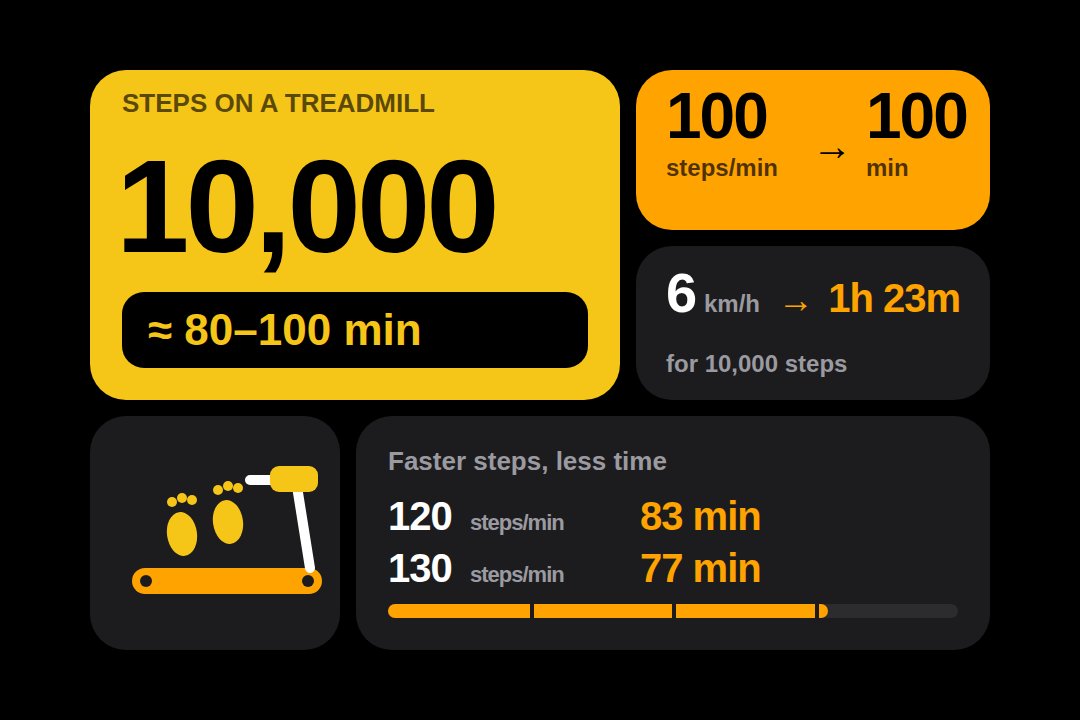
How Long Is 10,000 Steps on a Treadmill?
How long is 10k steps on a treadmill? Most walkers need 80 to 100 minutes. See times by speed and cadence, and how to split the total into a busy day.
Treadmill Pace Chart: Speed, Time and Mile Splits
A treadmill pace chart turns km/h and mph into per-mile and per-kilometre splits, so you can set the belt to the exact pace your training plan asks for.
🏃
Ready to take control of your run?
Connect Treadmill Pro to your treadmill and track every stat - right from your iPhone.


Free · iPhone, iPad & Android