


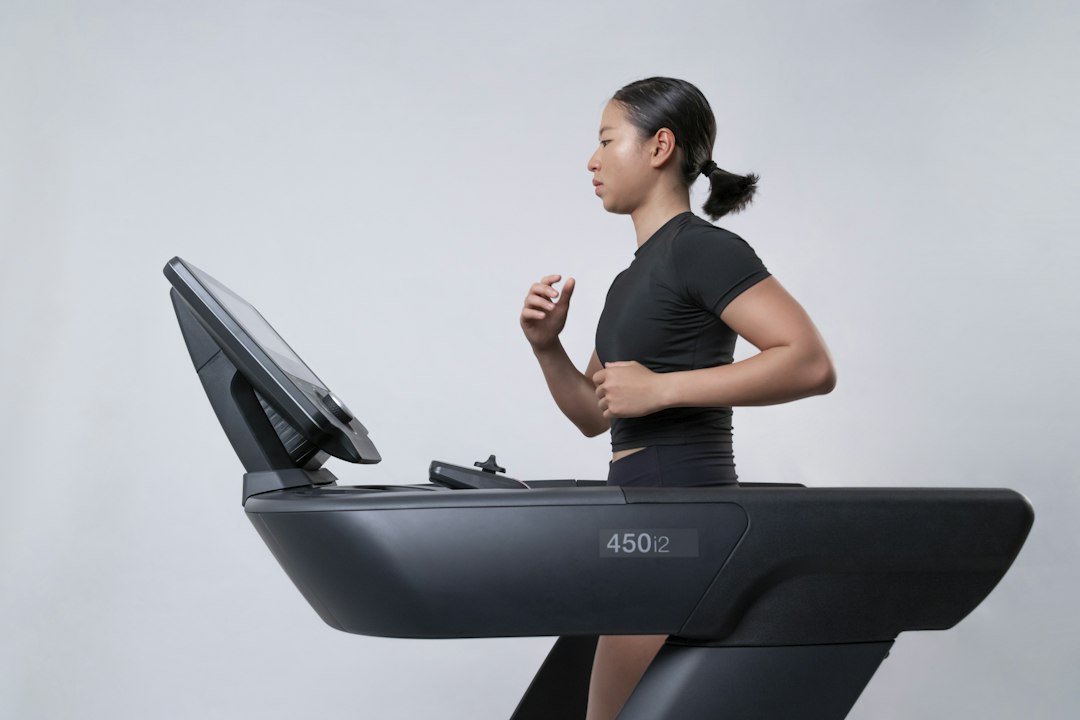
A treadmill mat is a sheet of dense rubber or PVC that sits between the machine and your floor. It costs a fraction of the treadmill, and it decides whether your hardwood stays unmarked, whether the people downstairs hear every stride, and how much carpet fluff ends up inside the motor housing. Most home setups benefit from one, but not every mat does the job, and a few common choices make things worse.
What the Mat Actually Does
People buy a mat for one reason and then find out it does three or four other things as well.
Floor protection. A loaded treadmill puts its full weight, plus yours, on four or six small feet. On hardwood, laminate or vinyl those feet leave dents over time, and the frame can scratch the surface when you fold or move the machine. Rubber spreads that load across a wider area.
Vibration and noise. Every footstrike sends a pulse through the deck, the frame and the feet into the floor. In a ground-floor room on a concrete slab, you will barely notice. On a suspended wooden floor or in an upstairs apartment, that pulse travels through the joists and becomes a dull thud in the room below. A mat takes some of the edge off. It will not soundproof a room on its own, and we go through the full set of fixes in our guide on how to reduce treadmill noise in an apartment.
Dust and debris control. The motor sits at the front of the machine, low to the ground, with a cooling fan pulling air through the hood. On carpet, that fan pulls in fibres, pet hair and dust. A smooth mat under the machine gives the air intake a cleaner surface to draw from and makes vacuuming around the treadmill much easier.
Stability. A firm mat stops the machine from creeping forward on smooth floors and evens out small irregularities, so the frame does not rock when you push off at higher speeds.
What a mat does not do: it does not add cushioning to your run. The belt and deck suspension handle that. A thick, soft mat can actually work against the deck, which we cover below.
When You Can Skip It
Not every setup needs one. You can reasonably go without a mat if:
- The treadmill sits on bare concrete in a garage or basement, and you do not care about marks.
- You already have rubber gym flooring (interlocking tiles or rolled rubber) covering the area.
- The machine is a light under-desk walking pad used at 3-5 km/h on a slab floor, where impact and vibration are minimal.
Even then, a mat is cheap insurance against sweat. Salt in sweat drips off the side rails and onto the floor, and over a few months it can stain wood and dull some finishes.
You should treat a mat as close to mandatory if you have hardwood, laminate or carpet, live above someone, or run rather than walk. Running at 10-12 km/h produces far more impact through the frame than walking at 5 km/h, and that difference shows up in both floor wear and noise.
How Thick Should a Treadmill Mat Be
Thickness is where most people go wrong, usually by assuming thicker is always better.
For most home treadmills, a mat in the range of 0.2 to 0.3 inches is the recommended thickness (BetterBike). Another 2026 buying guide lands in the same place, saying most home setups do well with a mat between 1/4 inch and 7 mm thick (HomeGear360). In practice that means roughly 5-7 mm.
Why not go much thicker? A few reasons:
- Soft mats let the frame flex. If the mat compresses unevenly under the feet, the frame can twist slightly with each stride. That puts extra stress on welds and bolts and can make the belt track off-centre.
- Height changes the feel. A thick, squishy base under a solid deck can make the whole machine feel wobbly, especially at incline.
- Thick mats on carpet compound the problem. Carpet is already soft. Adding a soft mat on top gives you two layers of give.
Thicker, very dense rubber (10 mm and up) does have a place: heavy commercial treadmills on upper floors, or when you are trying to cut vibration as much as possible. In that case, pick high-density rubber that barely compresses under a thumb press, not a foam yoga-style mat.
Sizing the Mat to Your Machine
The mat needs to be bigger than the treadmill’s footprint, not just the same size. One common rule is to measure the treadmill footprint and add 12 inches (BetterBike).
How to measure:
- Measure the full length of the machine from the front of the motor hood to the end of the rear rollers, with the deck down.
- Measure the full width at the widest point, usually the base of the uprights or the side rails.
- Add 12 inches to each dimension and use that as your minimum mat size.
The extra margin catches sweat dripping off the rails, gives you somewhere to stand when you step on and off, and keeps the feet from sitting right on the edge where the mat can curl.
If your machine folds, measure it unfolded. The mat has to support the machine in its working position, not its storage position. Our guide to the foldable treadmill with incline covers folding footprints if you are still choosing a model.
For compact machines and walking pads, standard 36 x 72 inch mats are often oversized. A smaller mat is fine as long as all the feet sit well inside it. If you are working with tight floor space, see our small treadmill guide for footprint numbers on compact models.
Material and Build Quality
Treadmill mats come in a few materials, and the differences are practical rather than cosmetic.
PVC (vinyl). The most common and cheapest option. Works well on hard floors, is easy to wipe clean, and is usually 5-6 mm thick. Lower-quality PVC can smell strongly for the first few weeks and, on some floor finishes, can discolour the surface underneath over time.
Rubber (natural or recycled). Heavier, denser and better at damping vibration. Recycled rubber mats have a noticeable smell at first that fades with airing out. Rubber grips the floor well, so the mat itself does not slide.
EVA foam tiles. Light and cheap, but too soft for a treadmill under running load. Fine for a stretching area next to the machine, not under it.
A few build details worth checking before you buy:
- Flat edges. Mats shipped rolled should lie flat within a day or two. Edges that keep curling are a trip hazard.
- Non-perforated surface. Holes or deep textures trap sweat and dust and make cleaning harder.
- One piece if possible. Seams between tiles can separate under the feet of the treadmill.
- Smell. If you train in a small room, look for low-odour or certified low-VOC materials, and unroll the mat in a ventilated space for a day before putting it down.
Hardwood, Carpet and Upstairs Rooms
The right mat depends a lot on what is under it.
Hardwood and laminate
Use a mat with a smooth, non-staining underside. Some rubber compounds react with polyurethane floor finishes and leave a yellow or dark imprint. If your floor is expensive or new, check the mat maker’s note on floor compatibility, or put a thin felt underlay between the mat and the wood. Clean under the mat every month or two so trapped grit does not scratch the finish.
Carpet
A firm, dense mat matters most here. The goal is to give the treadmill a stable base, since the carpet pile beneath it will compress unevenly. Low-pile carpet is easier to work with than shag. On deep carpet, some people put a sheet of plywood under the mat to spread the load before adding the mat on top.
Upper floors and apartments
A single mat helps but is rarely the full answer for neighbours below. The usual layering is a dense rubber base, then the treadmill mat, and in some cases anti-vibration pads under each foot. Walking at a moderate pace instead of running during quiet hours also makes a bigger difference than any mat. If you mainly walk, a quieter machine design helps too; see our walking treadmill guide.
Setting It Up and Keeping It Clean
Getting the mat down properly takes ten minutes and saves trouble later.
- Unroll the mat and let it flatten for 24-48 hours, ideally at room temperature.
- Clean the floor underneath first. Any grit trapped under the mat will grind into the surface.
- Place the mat with the margin evenly distributed, a little more at the rear where you step off.
- Set the treadmill on the mat with help. Do not drag it across, since that can bunch or tear the mat.
- Check that the machine is level using the adjustable feet. A mat can expose an uneven floor that the treadmill used to rest on unevenly.
- Run the belt at a slow walk for a few minutes and watch the tracking.
For ongoing care, wipe the mat with a damp cloth and mild soap after sweaty sessions, vacuum around the base weekly, and lift the treadmill off the mat every few months to clean underneath. Check the floor while you are at it for any marks or moisture.
Putting It Together
For most people, the choice comes down to a few decisions: a dense rubber or quality PVC mat, roughly 5-7 mm thick, sized at least 12 inches larger than the treadmill footprint, with a smooth underside if you are on hardwood. Spend a little more on density rather than thickness.
Once the setup is stable, the next thing to sort out is what you actually do on the machine. If you want to log every session and control speed and incline from your phone, Treadmill Pro connects to compatible treadmills over Bluetooth and syncs workouts to Apple Health, so you can see whether a quieter, more stable setup changes how often you train.